Employee Health Checkup vs Health Risk Assessment: An HR Guide
Learn what employee health checkups and digital health risk assessments reveal, where they differ and how employers can combine them responsibly.
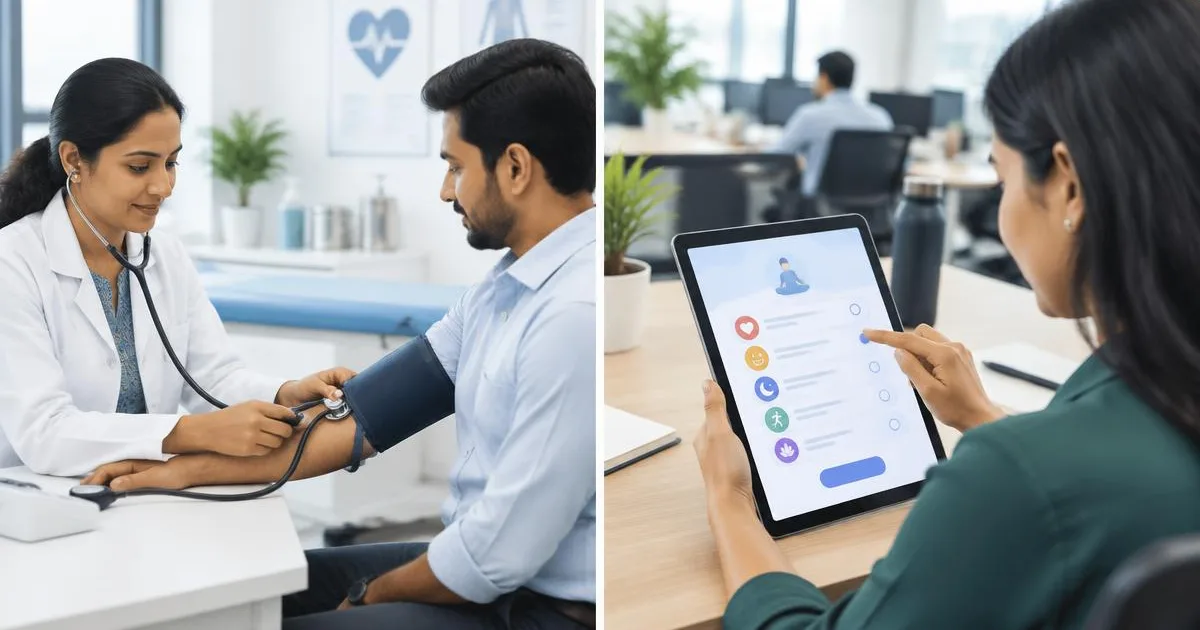
An annual health checkup and a health risk assessment (HRA) often appear together in a corporate wellness proposal. They are related, but they answer different questions. An HRA asks about lifestyle, history, work patterns and self-reported concerns; a clinical checkup may measure vital signs and include tests selected for a person's situation or job. Neither guarantees good health, and neither automatically establishes fitness for every job.
What a health risk assessment does
A digital HRA gathers context a laboratory value cannot: sleep, activity, tobacco exposure, perceived stress, family history or barriers to seeking care. A suitable risk summary can help employees decide which questions to discuss with a professional. Good implementation explains consent, purpose and the difference between private personal reports and aggregated programme insights. A questionnaire does not diagnose diabetes, heart disease or depression.
What a clinical health checkup does
A clinician may measure blood pressure, examine the employee, review medical history and order laboratory or other investigations where appropriate. The right package depends on age, symptoms, previous results, job exposures and clinical judgement. More tests do not automatically mean better prevention: results can mislead without context, and abnormal results need explanation and follow-up. Screening never replaces care when someone already has symptoms.
Side-by-side comparison
| Health risk assessment | Clinical health checkup | |
|---|---|---|
| Purpose | Identifies self-reported risk patterns and support needs | Evaluates selected measurable health factors |
| Inputs | Answers about habits, history and work context | Clinical history, examination and appropriate tests |
| Output | Non-diagnostic educational risk summary | Clinical findings interpreted by a qualified professional |
| Frequency | Set by programme goals | Set by medical advice and any role-specific legal duties |
| Employer access | Programme-level aggregate insights | Fitness opinions only through a distinct lawful clinical pathway |
How to combine them responsibly
- Define the objective: general prevention, chronic-disease risk follow-up, or role-based occupational surveillance.
- Get professional advice on both the HRA and the checkup design.
- Make scheduling convenient across sites and shifts.
- Deliver understandable personal reports privately.
- Offer counselling or clinical follow-up when indicated.
- Evaluate whether employees got appropriate support, not just whether tests were completed.
Three practical scenarios
For a mainly desk-based company, an HRA may show interest in sleep, movement and stress sessions, while a checkup addresses appropriately selected measurable risks. For an industrial plant, the hazard profile and legal duties may require additional occupational medical surveillance; a generic annual package is not a compliance substitute. For a company with several locations, digital appointment and follow-up tools can improve access, but central dashboards must never become unrestricted collections of medical records.
Health data is sensitive. In India, the Digital Personal Data Protection Act, 2023 and its Rules bring in obligations in phases, so confirm with legal advice which requirements already apply to your programme, alongside any sector or occupational health rules.
Procurement checklist for HR
Ask the provider who selects the tests and with what qualifications, how individual reports are delivered, whether follow-up is included, how consent and privacy work, which data reach HR, how contractors and shifts are covered, and how occupational fitness decisions are kept separate from voluntary wellness data. Get inclusions and exclusions in writing. Be wary of promised insurance savings, disease reversal or percentage improvements without robust evidence.
Next steps and related reading
Compare our employee health checkup packages, employee health risk assessment or request an HR programme proposal. Related: annual health checkup in India: employer guide and employee health risk assessment questionnaire.
The CDC Worksite Health ScoreCard describes combining assessment with policy-level workplace interventions.
Medical disclaimer: general educational guidance only; clinical and legal decisions need qualified review. Medical review of this article is pending.
FAQs
Can an HRA replace a blood test?
No. A questionnaire cannot measure laboratory markers.
Does every employee need the same test package?
No. Tests should be selected on clinical and job-specific needs.
Should HR get a copy of all test results?
Not by default. Use privacy safeguards and role-specific disclosure limits.
Share this article
Pick a tagline
The highlighted image above appears automatically as the preview picture on WhatsApp, LinkedIn and Facebook.
Related services
Want this for your workforce?
Start free with 25 employee health risk assessments and a corporate dashboard.
Get started for corporatesPlan this for your workplace
Discuss employee health checkup packages for your employee roles, locations and shift coverage.