
First aid training across India
First Aid and CPR Training for Employees in India
First aid training for employees teaches people at work how to respond in the minutes before medical help arrives — checking a casualty safely, calling for help, controlling bleeding, managing burns, fractures, eye injuries, choking and collapse, and starting CPR. Plan My Health runs hands-on first aid training at offices, factories, warehouses and construction sites across India, with certificates and renewal tracking.
This page covers the full first aid course, including its CPR module. For CPR and AED training in depth — floor wardens, AED placement and refreshers — see our CPR and AED training page.
~10 years in corporate health · PAN-India delivery · Trusted by teams at









Available across India, by state
Maharashtra
Delhi, Haryana and Uttar Pradesh
Karnataka
Tamil Nadu
Telangana
By site type
What first aid training covers
- Scene safety, primary assessment and calling for help with the right information
- Unresponsive casualty: recovery position, CPR basics and when to use an AED
- Severe bleeding, wounds and dressings; shock
- Burns and scalds, including chemical and electrical burns
- Fractures, sprains and immobilisation; suspected spinal injury
- Eye injuries and chemical splashes
- Choking in adults
- Fainting, seizures, asthma attacks and diabetic emergencies
- Heat exhaustion and heat stroke
- First aid box contents, record keeping and handover to the ambulance or doctor
Course formats
- Awareness session (2 to 3 hours) — for all employees: recognise an emergency, call for help, basic actions
- Workplace first aider course (half day to full day) — hands-on practice and a practical assessment
- Refresher course — shorter, focused on practice and changes since the last course
- Site-specific modules — chemical splashes, burns, work at height, heat illness or crush injuries as relevant
- Toolbox first aid talks — 15 to 20 minutes on one topic at shift start
Who should be trained in first aid
- Designated first aiders on every shift, in the numbers your state rules and headcount require
- Supervisors and line leaders, who are usually first on the scene
- Floor wardens, fire marshals and security staff
- Drivers, field staff and employees who work alone or in remote locations
- OHC support staff, receptionists and canteen teams
- Contractor supervisors on construction sites and in plants
How many first aiders each shift needs
Count the workers present on each shift, not the total headcount, and apply your state rules to that number. Then add margin for leave, weekly offs and turnover, and check that first aiders are spread across buildings, floors and remote work areas so one can reach any casualty quickly. A large shift in one building and a small night shift in another need different plans. We work through this with your EHS team and record the plan with the training register.
First aid for specific hazards
- Chemical plants: chemical splashes to eyes and skin, inhalation, use of eye-wash and safety showers
- Foundries and furnaces: burns and heat illness
- Engineering and assembly: crush, amputation and eye injuries from grinding and machining
- Electrical work: safe approach and electrical burns
- Warehouses and logistics: injuries from lifting, falling loads and vehicles
- Construction: falls from height, lacerations and heat stroke
- Offices: collapse, choking, fainting and minor injuries
Planning the training calendar
Train new first aiders soon after they are nominated, run refreshers before certificates lapse, and schedule short toolbox talks between courses to keep skills fresh. Avoid peak production periods and plan separate sessions for night shifts. For construction projects, plan training as new contractors mobilise rather than once at the start of the project.
First aid, OHC and ambulance working together
First aiders handle the first minutes; the OHC nurse or doctor takes over; the ambulance takes the casualty to hospital. Training includes how first aiders call the OHC, what information to give, and how to hand over. Where you have a standby ambulance, the drill includes it so the whole chain is tested.
Course outline by module
The standard course is built from modules; we choose and weight them to your site's hazards.
- Module 1 — Role of the first aider, scene safety, consent and calling for help
- Module 2 — Primary survey, recovery position and the unresponsive casualty
- Module 3 — Adult CPR and AED use (in depth on our CPR & AED page)
- Module 4 — Choking in adults and children
- Module 5 — Bleeding, wounds, shock and dressing
- Module 6 — Burns, scalds and chemical splashes
- Module 7 — Fractures, sprains and immobilisation; head and spinal injury
- Module 8 — Medical emergencies: heart attack, stroke, seizures, diabetes emergencies, asthma, fainting
- Module 9 — Heat stress, electric shock, falls from height and site-specific hazards
- Module 10 — First aid box contents, records and handover to medical staff
Duration options
- Awareness session (about 2 hours): for all employees — calling for help, CPR basics, choking and bleeding control
- Standard first aid course (one day): for nominated first aiders — all core modules with practical assessment
- Extended course (two days): for high-risk sites — adds site-specific hazards, mass-casualty basics and drills
- Refresher (half day): for previously trained first aiders
Certificates
Participants who complete the course and pass the practical assessment receive a Plan My Health course completion certificate showing the course, date and trainer. We do not claim affiliations or accreditations that are not stated on this page; if your client or regulator requires a specific external certification body, tell us at enquiry and we will confirm what can be arranged before you book.
Site-type variants
Office courses focus on medical emergencies, CPR and choking. Factory courses add machine injuries, chemical splashes, burns and confined spaces. Construction courses add falls from height, heat stress, crush injuries and remote-site evacuation. Each variant is delivered in English, Hindi or a regional language.
First aiders under the Factories Act and BOCW rules
The Factories Act, 1948 and state factory rules require first aid boxes and trained first aiders in proportion to the number of workers employed on each shift. The BOCW Act, 1996 and its rules set first aid duties for construction sites, and the OSH Code, 2020 carries these duties forward as states notify their rules. We help you work out how many first aiders each shift needs, train them and keep their certificates current.
Legal references on this page are general guidance. Exact requirements depend on your state rules, the processes you run and your headcount, so we confirm what applies to each site before we propose a scope.
First aid training for factories
Factory courses add the injuries that actually happen on your floor: crush and amputation injuries from machines, burns from hot surfaces and molten metal, chemical splashes, eye injuries from grinding, electrical injuries and heat illness near furnaces. Practice uses your own first aid boxes and eye-wash stations so first aiders know where everything is. Training is planned shift by shift so every shift has trained cover.
First aid training for construction sites
Construction courses focus on falls from height, cuts and lacerations, crush injuries, heat stroke, electrical shock and safe casualty movement on uneven ground. Sessions are delivered at the site office or labour camp, in the workers' language, with demonstration-led practice. Contractor supervisors are included so first aid cover follows the work front.
First aid training for corporate offices
Office courses emphasise collapse, CPR and AED use, choking, fainting, diabetic and asthma emergencies, minor injuries and evacuation. Floor wardens and fire marshals are a natural group to train first. For offices that want deeper CPR and AED capability, our CPR and AED training for employees adds more practice time and AED placement planning.
The CPR module inside the first aid course
Every workplace first aider course includes adult CPR: recognising cardiac arrest, calling for help, chest compressions at the right depth and rate on a manikin, and attaching an AED if one is available. This gives first aiders the core skill. Teams that need more — repeated AED practice, floor warden response plans or frequent refreshers — should add the dedicated CPR and AED course.
Hands-on practice and assessment
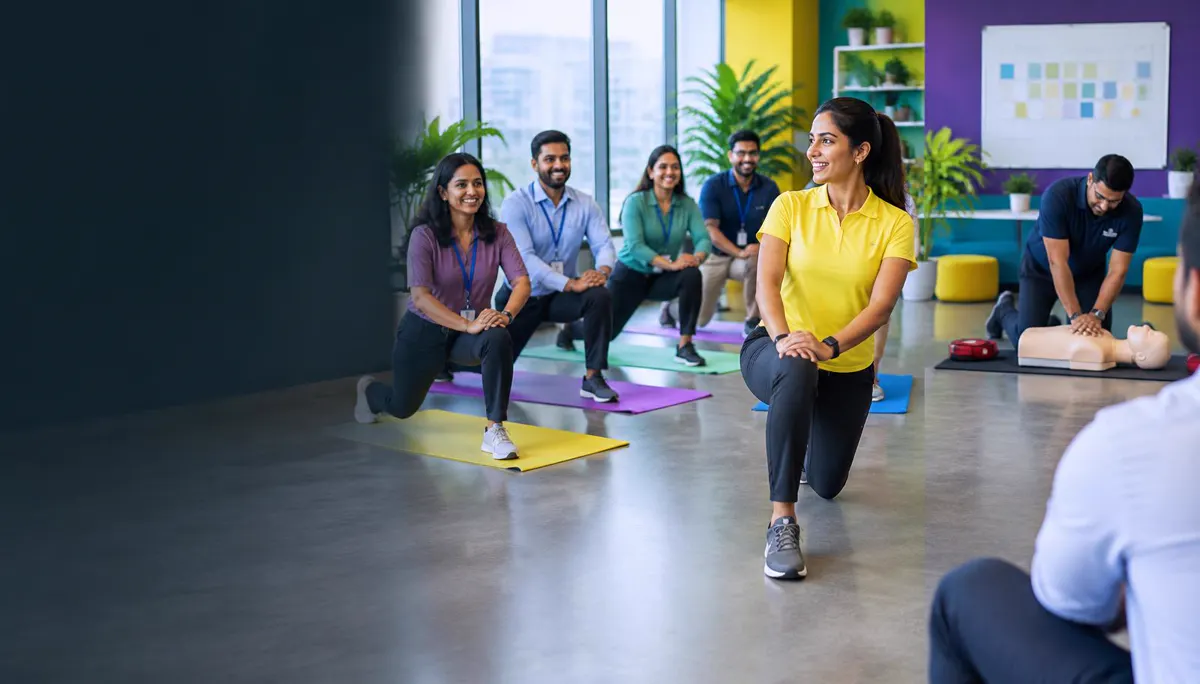
Most of the course is practice, not slides. Participants work on manikins, bandage each other, practise the recovery position and run short scenarios. Trainers assess each participant on practical skills before issuing a certificate. Groups are kept small enough for everyone to practise properly.
Certificates and renewal
Participants who complete the practical assessment receive a certificate with the course name, date and trainer details. We keep a digital record of everyone trained, by shift and location, and remind HR or EHS when refreshers are due so first aid cover does not lapse as people join, leave or change shifts.
First aid boxes and records
Training is only half of readiness. We review first aid box contents against your state rules and site hazards, check eye-wash and emergency equipment, and set up a simple register for every first aid case. These records help spot repeat injuries and support your safety reporting.
Emergency drills
After training, a mock medical emergency drill shows whether the plan works: how quickly a first aider reaches the casualty, whether the right equipment arrives, how the ambulance is called and guided in. We run drills with your EHS team and share a short report of what slowed the response.
Languages and trainers
Courses run in English and Hindi as standard, with Marathi, Gujarati, Tamil, Telugu, Kannada and other regional languages where trainers are available. Trainers are experienced in workplace first aid and adapt examples to your site type.
Choose training separately from emergency medical cover
- First aid training builds workplace response skills; CPR and AED practice has a distinct practical scope.
- Share the workplace hazards, trainee roles, shifts, language and available equipment to scope the course.
- Confirm trainer qualifications, assessment, certificate scope and refresher arrangements in writing. A training certificate does not establish an ambulance service or guarantee compliance.
What you get, who delivers it and how to start
What's included
- First aid, CPR and AED hands-on training
- Bleeding, burns, fractures, choking and chemical splash
- Drills and first-aider rosters for every shift
- Refresher reminders
Staff qualifications
- Qualified trainers with clinical or emergency-care background
- Sessions in English, Hindi and regional languages on request
Deployment timeline
Batches can be scheduled once headcount, shifts and venue are confirmed; large sites are trained over several shift-wise batches.
Service coverage
Delivered PAN-India through our Mumbai team and partner network — with regular work in Mumbai, Pune, Ahmedabad, Delhi NCR, Bengaluru, Hyderabad and Chennai — for corporate offices, factories and plants, warehouses and construction sites.
Compliance documentation provided
- Attendance and assessment records
- Participant certificates
- First-aider roster by shift
Formats follow your applicable state rules; consult the applicable state rules for exact requirements.
Pricing approach
A custom quote based on headcount, shifts and sites — no fixed rate card, and the first consultation is free.
How to request a proposal
Fill in the short form below, or call, WhatsApp or email us. We reply within one working day with a scope and quote.
Medical governance
- Qualified MBBS doctors lead every clinical service; AFIH-qualified doctors are deployed where a process requires one.
- Trained nurses (GNM, BSc or ANM) and paramedics work under doctor oversight and written protocols.
- Clinical oversight: reports and fitness opinions are reviewed by a doctor, with escalation for abnormal results.
- Confidentiality: individual health records are shared only with the employee; HR receives aggregate data and the fitness opinions a role legally needs.
- Data privacy: records are stored digitally with access limited by role.
Frequently asked questions
What does first aid training for employees include?
Casualty assessment, calling for help, bleeding, burns, fractures, eye injuries, choking, collapse, CPR basics, heat illness and first aid records.
How long is a first aid course?
Awareness sessions take 2 to 3 hours; workplace first aider courses run from a half day to a full day.
Does the first aid course include CPR?
Yes, adult CPR and an introduction to AED use. For deeper CPR and AED training, see our dedicated CPR page.
How many first aiders do we need?
It depends on your state rules and the number of workers on each shift. We work it out shift by shift.
Do participants get a certificate?
Yes, after passing the practical assessment, with renewal dates tracked digitally.
How often should first aiders be retrained?
Refreshers are typically planned at regular intervals; we track due dates and remind you.
Can you train construction workers on site?
Yes, at the site office or labour camp, in their language, with demonstration-led practice.
Can training be done in Hindi or regional languages?
Yes, where trainers are available for that language.
Do you check first aid boxes?
Yes. We review contents against your state rules and site hazards as part of the programme.
Do you run emergency drills?
Yes, mock medical emergency drills with a short improvement report.
What certificate do participants get?
A Plan My Health course completion certificate after the practical assessment. External certification requirements are confirmed at enquiry.
Can the course be adapted for our site?
Yes — office, factory and construction variants, in English, Hindi or regional languages.
How is the price worked out?
Every proposal is a custom quote based on headcount, number of shifts, the sites involved and the scope you choose. We do not charge for the first consultation.
How do I request a proposal?
Use the proposal form on this page, call +91 8356928929 or +91 9820891087, WhatsApp us, or email akshay@planmyhealth.in. We reply within one working day.
Related services
Guides for HR and EHS teams
Cities we serve
Get a quote in 24 hours
Share your company, city, headcount and the service you need — we reply within one working day with a scope and quote.