
Audiometry and spirometry at work: who needs them and how often
Which workers need hearing and lung function tests, how often to repeat them, and how to turn results into real noise and dust controls.
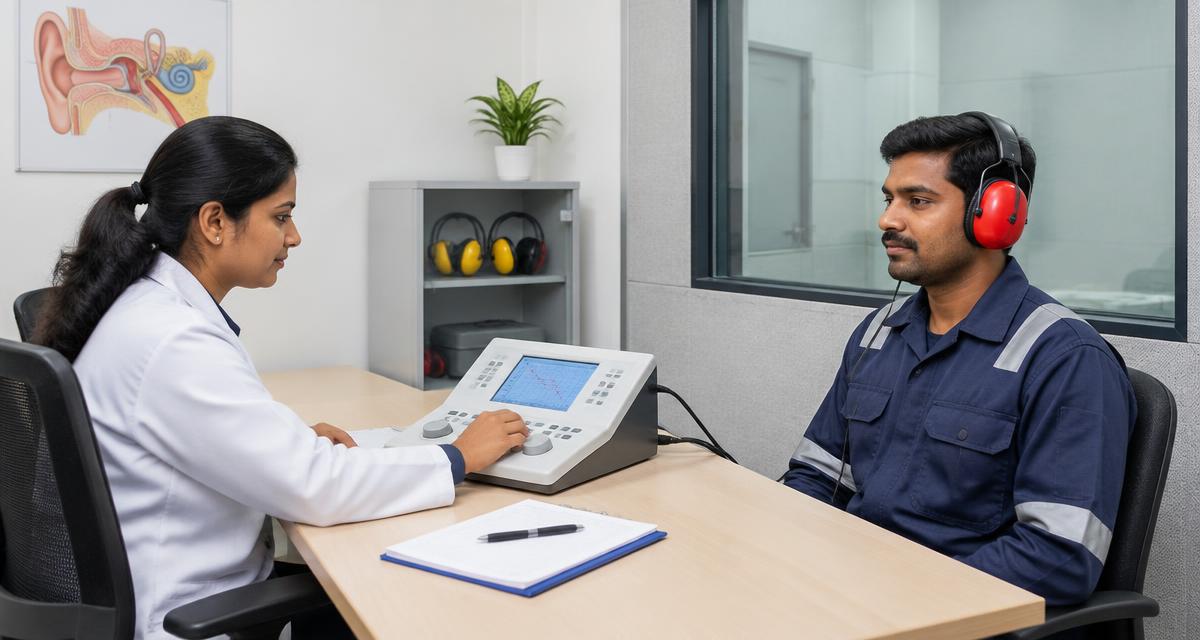
Audiometry (a hearing test) and spirometry (a breathing test) are the two most common hazard-linked tests in Indian factories. Both are simple, quick and non-invasive. Both are also frequently wasted, because results are filed instead of compared year on year. This guide explains who should be tested, how often and what to do with the numbers.
Audiometry: hearing tests
Who needs it
Workers regularly exposed to high noise: press shops, compressors, generators, textile looms, grinding and fabrication, bottling lines, construction equipment and similar. The decision should come from a noise survey of the work areas, not guesswork. If people have to shout to be heard at arm's length, measure.
How often
A common pattern is a baseline before or at joining, then a periodic test, often yearly, for exposed workers. Repeat sooner if a worker reports hearing loss or ringing, or after a change in process. Check the applicable state rules and your industry standards, which may set a specific frequency.
Getting a valid test
Testing should be done in a quiet booth or room, ideally after a period away from noise so that temporary hearing changes do not distort the result. Calibrated equipment and a trained technician matter more than the brand of the machine.
Spirometry: lung function tests
Who needs it
Workers exposed to dust, fumes, gases or vapours: cement, silica and stone, foundries, welding, paint shops, chemicals, pharmaceuticals, cotton and grain handling, and some construction tasks. Workers who use tight-fitting respirators may also need a fitness assessment.
How often
Again, a baseline at joining, then periodic testing for exposed workers, commonly yearly or as your doctor advises based on the exposure. Check the applicable state rules for hazardous processes, where specific schedules may apply.
Getting a valid test
Spirometry depends on effort and technique. A trained operator should coach the worker and repeat the blow until results are consistent. Poor technique produces false abnormal results that worry workers unnecessarily.
Comparing results over time
The real value of both tests is the trend for each person and for each work area. A single result tells you little; a drop compared with the baseline tells you something changed. Ask your provider for:
- Each worker's result compared with their own baseline
- A list of workers with a significant change, with follow-up actions
- A department-level summary to show where controls may be failing
From results to controls
Testing is not a control. If hearing or lung function is falling in one area, the answer is to reduce exposure: enclose machines, maintain silencers, improve ventilation and extraction, use wet methods for dust, and make sure hearing protection and respirators fit and are worn. Retest to show the controls worked.
Confidentiality and communication
Explain each result to the worker in simple language. Share department trends with management, and share individual fitness outcomes with HR only as needed.
Planning a testing round
Schedule tests by shift and department so production is not disrupted, and keep the equipment and operator consistent from year to year where possible.
Reading the reports
Ask your provider to explain results in plain terms on a single page per worker: today's result, the baseline, the change and the action. For audiometry, the pattern of loss across frequencies helps the doctor judge whether noise is a likely cause. For spirometry, the doctor will look at measures of how much and how fast air can be breathed out, compared with the worker's own baseline and expected values for age, height and sex. Avoid labelling workers from a single test; confirm significant changes with a repeat test before drawing conclusions.
Linking tests with exposure monitoring
Health tests are strongest when paired with workplace measurements. Keep noise surveys and dust or fume monitoring results alongside the health data, so that a change in a worker's result can be checked against the exposure in their area. Together they show whether controls are working and where to invest next.
Common mistakes to avoid
- Testing everyone instead of the workers actually exposed, which wastes budget and attention.
- Testing workers straight off a noisy shift, which can show temporary hearing changes as permanent loss.
- Changing equipment or providers every year without keeping results comparable to the baseline.
- Filing reports without telling workers what their results mean.
- Treating hearing protectors or respirators as the only control instead of reducing noise and dust at source.
- Not linking abnormal results to a follow-up review with the doctor and the area supervisor.
Next steps
Start with a walk-through and a noise and dust survey, list the exposed roles, and set baselines for any exposed workers who do not have one. Then schedule periodic testing and a yearly review of the trends with production and EHS.
Plan My Health runs audiometry, spirometry and hazard-linked tests onsite for factories. See how a testing round works on our factory worker health checkup page.
FAQs
Do office workers need audiometry or spirometry?
Usually not, unless they work in noisy or dusty areas. Testing should follow measured exposure.
What if a worker's hearing has dropped since the last test?
The doctor should confirm the result, check for non-work causes, review the worker's exposure and protection, and recommend controls and follow-up.
Can these tests be done onsite?
Yes. Both can be done onsite with calibrated portable equipment, provided a quiet room is available for audiometry.
Share this article
Pick a tagline
The highlighted image above appears automatically as the preview picture on WhatsApp, LinkedIn and Facebook.
Want this for your workforce?
Start free with 25 employee health risk assessments and a corporate dashboard.
Get started for corporatesPlan this for your workplace
Discuss factory medical checkups and health surveillance for your employee roles, locations and shift coverage.